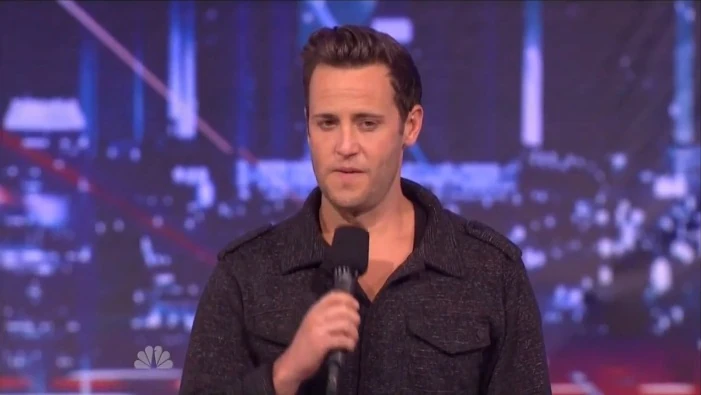
There is a distinct, heavy stillness that descends upon a theater right before an artist lays their soul bare. Under the relentless glare of the television lights, the polished stage can feel less like a launchpad to stardom and more like an emotional precipice. When Branden James walked out into that blinding glow, he carried no arrogance, no manufactured swagger, and no desire for cheap spectacle. Instead, the 34-year-old Chicago native carried an invisible archive of sorrow, years of quiet longing, and a heart beating furiously against his ribs.
To the thousands in attendance and the millions watching at home, he was merely the next contestant in a relentless parade of aspiring talent. But for Branden, walking onto the America’s Got Talent stage was not just a career gambit; it was an act of profound defiance against the shadows of his past. Raised in a devoutly conservative household, Branden had spent the formative chapters of his life learning how to shrink. In his family’s tight-knit world, rigid expectations left little room for deviation, and discovering that he was an openly gay man had triggered an agonizing rift that fractured his closest relationships.
For years, the people who brought him into this world wrestled deeply with his reality. The disapproval cut straight to the bone, sparking an era of painful distance where love felt tangled in ideological conditions. Yet, amidst the isolation, Branden had found a faithful sanctuary in classical music. While ordinary words failed to bridge the chasm between who he was and who his family wanted him to be, the soaring architecture of opera gave his grief a sacred home. In the grandeur of high tenors and timeless arias, he found a universe where intense passion wasn’t considered a defect—it was considered divine.
Perhaps the most arresting detail of this fateful afternoon was seated just a few dozen rows back in the theater seats. There, nestled quietly among the spectators, was Branden’s mother. Their journey had not been smooth; it was marked by fraught conversations, long silences, and the slow, arduous labor of reconciliation. She was there not because they had solved every difference, but because love was fighting to outlast dogma. She was there to witness her son in his element, even if the world they each inhabited still felt worlds apart.
When the introductory chatter faded and Branden closed his eyes at the microphone, the silence in the auditorium grew taut. He drew in a single, grounding breath—a breath that seemed to gather every tear shed in private, every prayer murmured in self-doubt, and every rejection he had ever absorbed. Then, he opened his mouth, and the world shifted on its axis.
The first note did not merely travel across the room; it commanded it. Delivering a soaring operatic masterpiece, Branden unleashed a voice of astonishing purity, rich with velvety low tones and celestial upper registers that rattled the theater’s historic walls. It was not the sterile, polite perfection of an academic recital. It was a torrential outpouring of raw, visceral humanity. Every syllable dripped with years of unspoken longing, echoing the universal ache of wanting nothing more than to be seen, embraced, and loved without condition.
Across the judges’ desk, cynicism dissolved in an instant. Heidi Klum sat mesmerized, running her hands along her arms as the emotional resonance visibly shook her. Mel B leaned forward, her eyes wide with reverence as the notes ascended into the rafters. The audience, usually primed for quick cheers and theatrical antics, fell into an awed, almost reverent hush. They were witnessing a man transmute his private agony into gold, transforming an entertainment competition into a cathedral of shared vulnerability.
As the piece reached its towering crescendo, Branden poured every ounce of his remaining strength into a final, dazzling note that hung suspended in the air like a bolt of lightning. For a split second after the sound dissipated, nobody breathed. Then, like a dam breaking open, the entire theater exploded into a deafening, unified standing ovation. Thousands of strangers leapt to their feet, their applause rolling through the venue in waves of thunderous validation.
On stage, the stoic composure Branden had maintained began to crack. His shoulders dropped, tears welled in his eyes, and a radiant, disbelieving smile spread across his face. The burden he had carried into the room had suddenly been lifted, carried away on the very breath he used to sing his truth.
When the panel spoke, their words carried an emotional weight that went far beyond typical talent show critiques. “I have goose pimples all over,” Heidi confessed, still visibly moved by the power of the performance. But the defining emotional climax of the day came when Howard Stern bypassed standard praise and looked out past the stage lights, directly into the audience. Addressing Branden’s mother with unwavering earnestness, Howard urged her to recognize the rare beauty standing before her, reminding her that she had every reason in the world to be profoundly proud of her son’s extraordinary courage and singular gift.
The camera found his mother’s face—a portrait of pride, humility, and the quiet dawn of deeper understanding. In that singular exchange, something ancient and broken seemed to mend. Branden had not changed who he was to win acceptance; he had simply stood firm in his truth and let his authentic brilliance do the speaking.
With four resounding “Yes” votes, Branden secured his ticket to the iconic stage of Radio City Music Hall, but his true victory had already been achieved long before the votes were tallied. His performance served as an enduring reminder that true art does not hide from suffering—it confronts it, honors it, and turns it into light. In singing for his life, Branden James proved that the most powerful thing a person can ever do is refuse to be quieted, and that music, at its highest peak, has the miraculous power to heal the deepest wounds of the human heart.
Watch the full video below: